
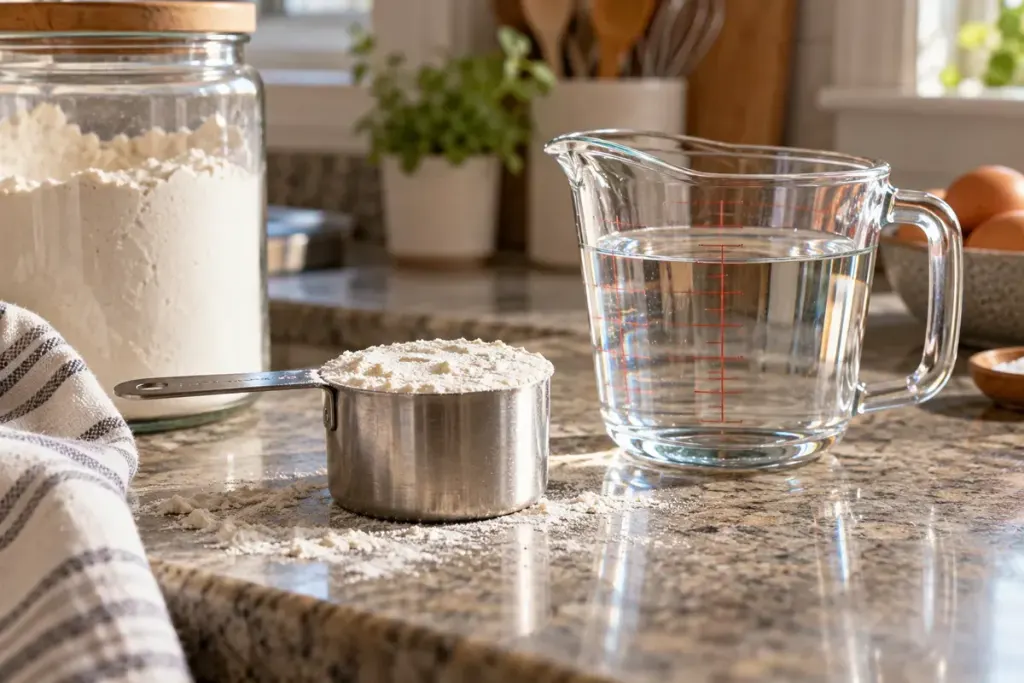
A dry measuring cup is filled to its rim and levelled. A liquid measuring jug has space above its marked volume so the liquid can be carried without immediately spilling. The designs support different ways of filling and reading, even when both refer to volume.
King Arthur Baking’s recipe-success guide recommends dry cups for dry ingredients and a marked liquid cup for liquids, while favouring a scale when the recipe supplies weights. The tool and the measuring method work together.
Look at what the rim allows you to do
With a dry ingredient, a level rim provides a reference for sweeping away excess. Trying to level flour at a line halfway down a jug is less straightforward. Conversely, filling a dry cup with water right to the edge makes it easy to lose some on the way to the bowl.
That does not mean dry and liquid versions of the same defined cup unit represent different volumes. The distinction here is usability and the specified filling method. Cup standards can differ between countries and recipe sources, so check the recipe’s units separately.
Do not confuse a container with a weight conversion
A cup of flour and a cup of water do not have the same mass merely because they occupy the same stated volume. If the recipe gives grams, use those grams with a suitable scale rather than applying a generic cup-to-gram conversion.
For a simple kitchen comparison, fill a dry cup with a dry ingredient using the recipe’s method and observe how the excess can be levelled. Then use cool water in a liquid jug and notice the spare space above the line. The exercise demonstrates the design without requiring you to bake two full recipes.
Keep sets identifiable. A missing half-cup replaced by a similar-looking serving scoop can introduce an error before technique even enters the picture. Worn markings on a jug are also a reason to review whether it remains easy to read.
Choose the tool that makes the specified measurement repeatable. More specialised equipment is not always necessary, but a clear reference edge or line makes a practical difference when ingredients must reach the bowl in consistent amounts.