
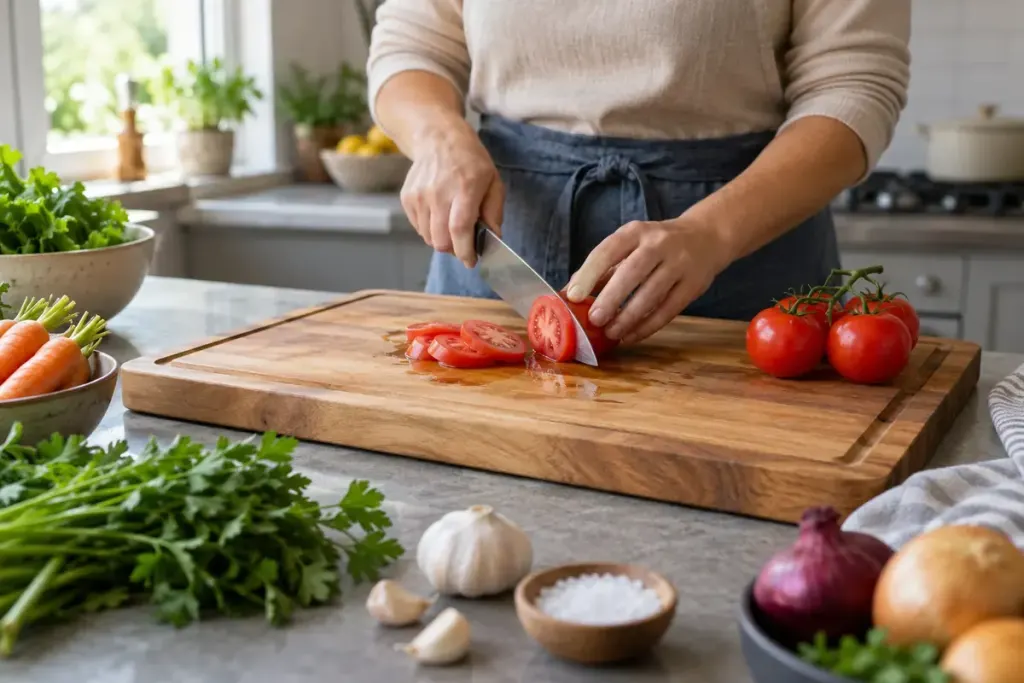
A groove around a cutting board’s edge can catch some liquid before it reaches the worktop. That feature is useful for certain jobs, but it also removes part of the uninterrupted flat surface. On a board designed for use on both sides, the better face depends on what you are preparing.
First check that the board is genuinely reversible. Feet, handles, shaped undersides or manufacturer restrictions may make only one face suitable for cutting.
Match the surface to the task
A grooved side can help contain liquid from juicy ingredients or carving, within the groove’s limited capacity. It is not a watertight tray, so keep an eye on accumulation and avoid tipping the board carelessly.
A broad flat side may be more convenient when gathering chopped herbs or moving small dry pieces into a bowl. Use an appropriate scraper rather than dragging a sharp edge in a way that could damage the knife or board.
For an illustrative preparation sequence, someone might use the flat face for dry bread pieces and a separate appropriate board for wet ingredients. The choice should support a safe, clean workflow rather than a rule that one face is always superior.
Do not confuse two faces with two clean boards
Turning a used board over is not a substitute for proper cleaning or separation of raw and ready-to-eat foods. Contamination can reach the worktop, edges and hands. USDA guidance on cutting-board cross-contamination recommends clean boards and, where possible, separate boards for produce and raw meat, poultry or seafood. Follow the manufacturer’s cleaning instructions too.
Pay attention to the groove during cleaning, where small pieces can collect. Check the surface for damage, deep scoring or other conditions that make it difficult to maintain appropriately.
Check stability each time
Place the board on a secure, suitable surface and confirm that it does not rock or slide. Reversing it may change how it sits, especially if the board has warped or the worktop is uneven.
A groove is a practical design detail with a limited job. Treating it as one factor among surface area, stability and cleaning makes the board easier to use well.