
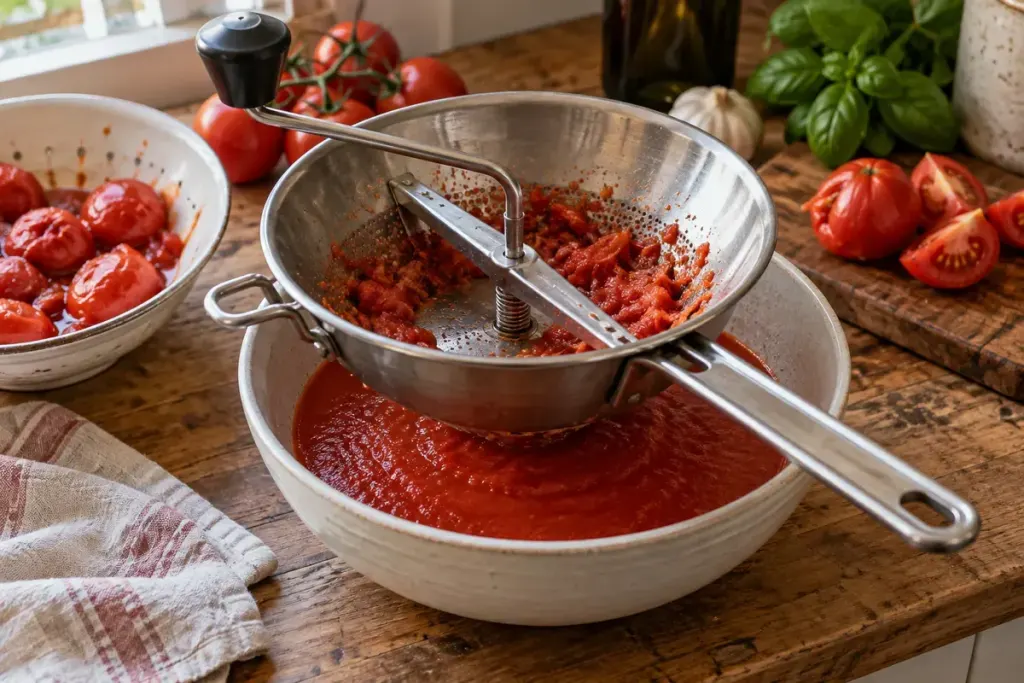
A blender breaks ingredients into smaller pieces. A food mill presses suitable food through a perforated disc, leaving some material behind. That difference is useful when you want a puree while separating skins or seeds that are too large to pass through the chosen holes.
Choose the disc for the food and texture
Disc openings vary, and a mill does not guarantee that every seed will be removed. Match the disc to the ingredient and the desired result. The OXO food-mill instructions show how its discs are fitted and describe reversing the handle to redistribute food. Follow the instructions for your own model rather than assuming all mechanisms assemble the same way.
Prepare the produce as the recipe requires, removing hard stones and unsuitable parts first. A mill is not a way to make inedible material safe or to force hard pieces through a delicate screen.
Work in manageable amounts
Set the mill securely over a suitable bowl or pot and add a modest quantity. Turn the handle as directed, watching that the receiving container remains stable. Take particular care with hot food and steam.
For an illustrative comparison, pass a small amount of cooked tomato through one suitable disc and inspect the puree before processing the full batch. This lets you judge the texture and seed separation without committing the entire pot to a result you may not want.
Keep the separated material separate
When emptying the mill, avoid tipping the retained skins or seeds into the finished puree. Scrape the underside only with an appropriate utensil and stop turning before reaching into the mechanism. Clean the disc and moving parts according to the care instructions.
Taste and season after checking the texture. If the puree will be preserved, use a tested preservation recipe and process; passing food through a mill does not establish that it is safe for storage at room temperature.