
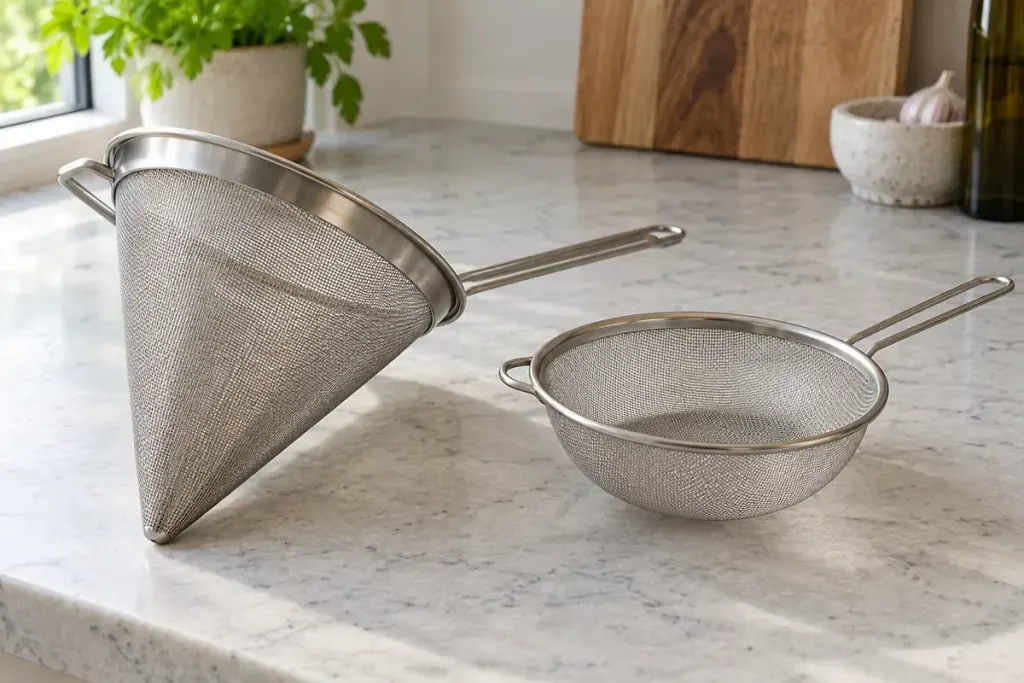
A conical chinois and a round sieve can both separate liquid from solids, but they organise the job differently. The shape affects where material gathers, how the tool is supported and how easily you can work against the mesh.
Look at the actual construction
“Chinois” describes a familiar conical form, but products vary in mesh fineness, reinforcement and size. A fine-mesh sieve can also be very fine. Compare the opening size and build rather than assuming the conical tool always produces the smoother result.
Check the support. The tool should sit securely over a suitable container without needing one hand to prevent it tipping. A deep cone may require more vertical clearance than the bowl you normally use.
Decide whether you want to press
For a puree or sauce, gentle pressure with a suitable utensil may help move soft material through the mesh. For a liquid intended to remain clear, forcing solids through can work against the desired result. Follow the recipe’s instruction rather than pressing simply because the tool allows it.
Do not use a sharp implement that can damage the mesh. With hot liquids, use a stable setup, manageable quantities and appropriate protection against splashes. Never balance a heavy pot over an unstable strainer.
Give the cone room to drain
Set the chinois in its appropriate stand or secure support and check where its tip ends. If the receiving container is shallow, strained liquid can rise around the cone before the job is finished. Stop and transfer the collected liquid to another suitable vessel rather than trying to lift a loaded, dripping strainer with one hand.
For a cold practice setup, pour a small amount of water through the supported tool. This lets you check clearance and stability before working with a heavy hot sauce. A deep container and a correctly sized stand may solve a practical problem that changing to a finer mesh would not address.
If you already own a sieve, test it on the dish you actually make before buying another tool. The question is specific: does the current tool give the texture, support and working space you need? A new shape is valuable when it solves that problem.