
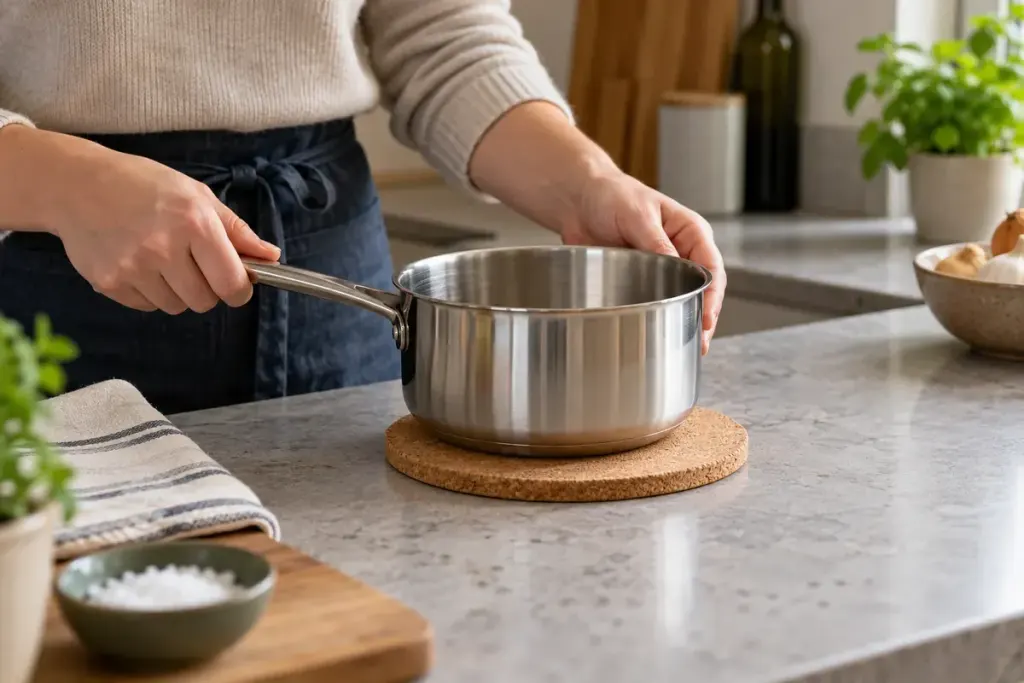
A hot pan needs somewhere stable to land before it leaves the hob. A trivet helps only when it is suitable for both the cookware and the surface underneath it.
Start with the worktop manufacturer’s care instructions and the trivet’s stated use. Heat resistance is a product-specific claim. It should not be interpreted as permission to place any pan, at any temperature, on any counter for an unlimited time.
Check fit and stability
The pan should sit securely without rocking or balancing on a narrow edge. Consider its base, weight and handles. A small mat that works for a mug may not provide stable support for a broad, heavy casserole.
Place the trivet on a clean, dry, level area with room around the handles. Keep it away from the counter’s edge and from children who could pull on a handle. Plan the position before lifting a full pan so you do not need to rearrange objects while holding it.
Read the limitations, not just the material name
Silicone, cork, metal and wood products can have different designs and limits. Look for instructions about direct heat, prolonged contact, cleaning and the types of surfaces they suit. A decorative board is not automatically intended as a hot-pan stand.
Do not use a damp folded cloth as a substitute without considering heat transfer and stability. Do not put a trivet on an active hob or use it as cookware unless the product is specifically designed for that purpose.
Inspect for cracks, loose feet, warping or contamination that could make the support uneven. Replace a damaged item rather than compensating by placing another unstable object beneath it.
If the compatibility information is unclear, ask the worktop or trivet manufacturer before relying on it. The safest everyday routine is prepared in advance: suitable support, a clear landing space and a controlled lift with appropriate hand protection.