
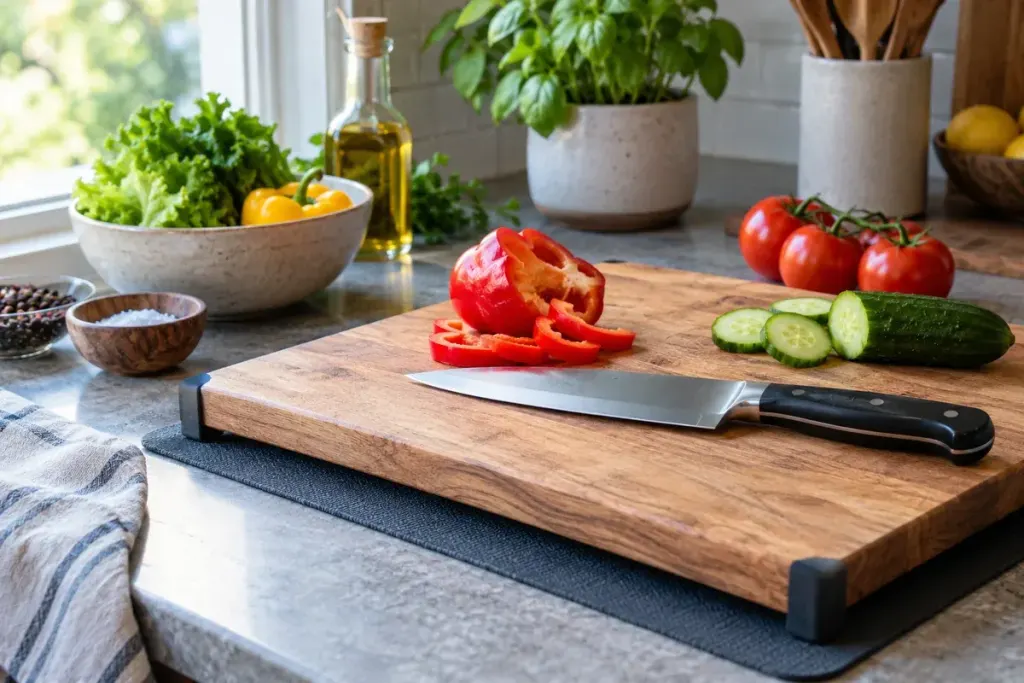
The knife is sharp, the vegetables are ready and the cutting board slides as soon as you begin. Better equipment does not compensate for an unstable work surface.
Before focusing on chopping speed, make the setup dependable. The board should fit the task, sit securely and allow you to work without reaching around clutter.
Check the board before the food
Place it on a clear, appropriate surface and use a suitable non-slip support if needed, following the board’s care instructions. Check that it does not rock. A warped board or worn support may need replacement rather than a more elaborate arrangement underneath.
Choose enough space for the ingredient and the cut pieces. An oversized vegetable balanced on a tiny board invites awkward handling. Keep the knife resting safely when not in use, with its edge away from where someone may casually reach.
Keep stability and hygiene together
The USDA FSIS guidance on cutting-board cross-contamination explains the importance of separating raw animal foods from ready-to-eat foods and cleaning equipment appropriately. Material choice does not remove the need for that routine.
Follow the manufacturer’s cleaning instructions and applicable food-safety guidance. Inspect grooves and damage that make effective cleaning difficult. A board should be suitable for both the preparation task and the way you can realistically maintain it.
Slow down the unfamiliar cut
Use a knife suited to the task and learn safe handling from a competent instructor or reliable demonstration. Do not try to reproduce a professional’s speed before you understand the grip and movement. Secure or prepare unstable ingredients using an appropriate technique.
Keep attention on the work, especially when others share the kitchen. If interrupted, put the knife down safely rather than gesturing with it. Never try to catch a falling knife.
Reset between tasks
Move prepared food to a suitable container, clear scraps and clean the board and knife as required before changing food types. Do not let a crowded pile push the working area closer to an edge.
At the end, store the clean, dry equipment appropriately and check whether the setup still needs adjustment. The useful improvement is often modest: a board that stays still, a clear workspace and a sequence that makes safe handling easier than improvisation.