
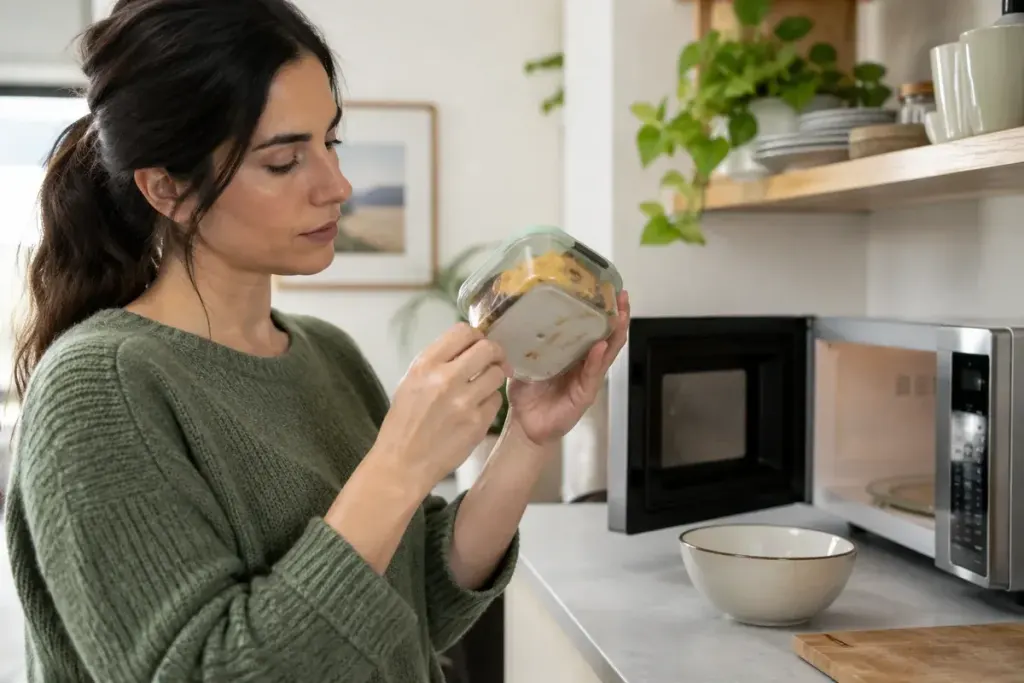
A container is labelled microwave safe, so it goes from the freezer to the microwave with its lid tightly clipped shut. The label may support microwave use, but it does not necessarily permit that entire sequence.
Kitchen labels answer specific questions. The safest approach is to read the conditions of use for both the container and its lid rather than treating one symbol as permission for every appliance.
Check the exact product instructions
Look for guidance on reheating, venting, temperature changes and duration. A lid may have different restrictions from the base. Oven-safe, freezer-safe and dishwasher-safe are separate claims and should not be inferred from microwave suitability.
The FDA’s microwave-oven guidance recommends appropriate cookware and following instructions. Its melamine tableware guidance is a reminder that not all attractive, durable serving ware belongs in a microwave.
Do not guess from the material alone
Glass, ceramic and plastic products vary in their intended use. Decoration, construction and condition can matter. A recycling code identifies material information; it is not a universal microwave-use approval.
If instructions are missing, check the manufacturer’s information for the exact item or use a clearly suitable alternative. Do not rely on a visual resemblance to another bowl in the cupboard.
Consider heat and steam during handling
Follow venting instructions and take care when removing lids or covers, as hot steam can escape. The food can heat the container even when the material is suitable for the appliance. Use appropriate protection and place the container on a stable surface.
Follow reliable food-safety instructions for reheating, including stirring or standing time where relevant. A suitable container does not guarantee that the food has heated evenly or reached an appropriate temperature.
Keep a simple kitchen distinction
It can help to store microwave-use containers together and keep their matching lids nearby. Retain product information for items with specific limits. Stop using damaged containers where the manufacturer advises replacement, and do not repurpose single-use packaging beyond its intended use.
The useful habit is to ask a complete question: “Is this item, with this lid, suitable for this food and this heating method?” That takes only a moment, but it is much more informative than asking whether a symbol somewhere on the base looks familiar.