
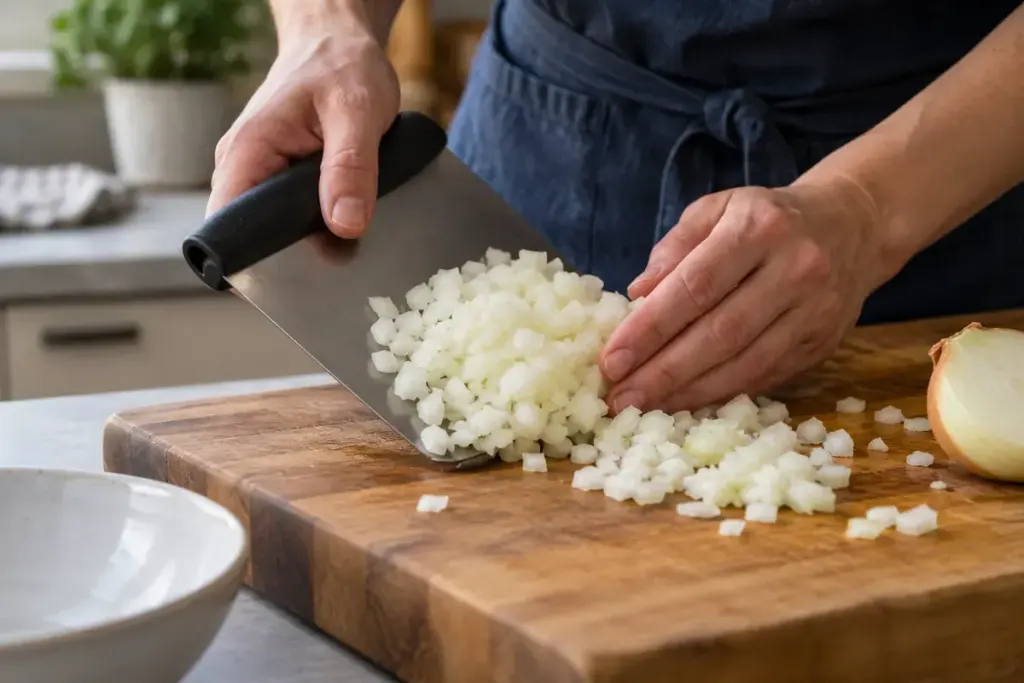
After chopping an onion, the knife is already in your hand, so sweeping its cutting edge across the board feels convenient. A bench scraper offers a broad surface for the transfer and lets the knife return to its cutting job.
Choose a food-safe scraper suited to the task and board. Some have rigid metal edges, while others are flexible plastic. Follow the tool’s care instructions and check that its edge and handle are undamaged.
Bring the bowl close
Set the receiving bowl on a stable surface beside the board. Gather a manageable amount of chopped food with the scraper, keeping fingers away from any sharp edge. Lift only as much as you can control, and guide it into the bowl without reaching across a hot pan.
For a large pile, make several small transfers. Trying to balance everything on one scoop can scatter ingredients and encourage an awkward catch with the other hand.
Keep the knife in a safe, visible position while you transfer. Do not bury it under scraps or leave its handle projecting beyond the worktop. If you need to move between chopping and transferring repeatedly, give each tool a clear resting place.
Use it for the food, then clean it properly
A scraper can gather loose pieces efficiently, but it does not sanitise the board. After preparing raw meat or other foods requiring separate handling, clean and sanitise the relevant surfaces and tools according to appropriate food-safety guidance before moving to ready-to-eat ingredients.
Do not use a food scraper interchangeably with a household paint or cleaning scraper. Similar shape does not establish that a tool is suitable for food contact.
After use, wash and dry it as instructed, paying attention to the join between blade and handle. Store it where the edge cannot cause an accidental cut. The small change in workflow is simple: cut with the knife, transfer with a suitable broad tool, and keep both jobs controlled.