
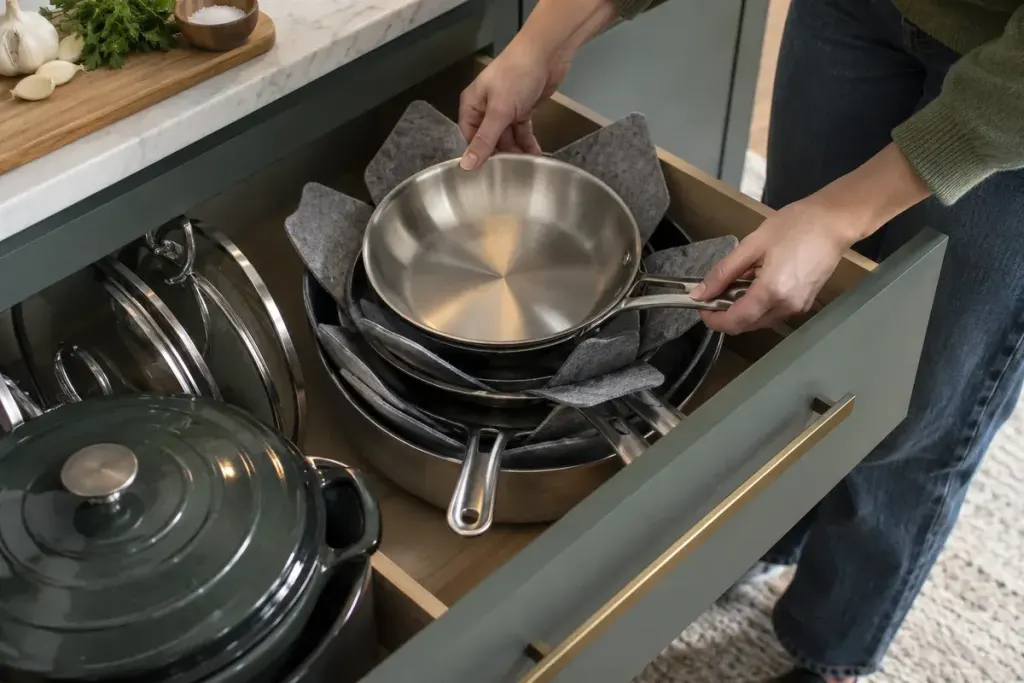
Nesting pans can recover a surprising amount of cupboard space. It can also put the rough underside of one pan against the cooking surface of another every time someone reaches for dinner equipment.
Check the surfaces that touch
Follow the cookware manufacturer’s storage guidance, particularly for coated or delicate surfaces. Use suitable clean, dry separators where recommended. A protector should cover the contact points without preventing the stack from sitting securely.
Do not nest pans while damp simply because they have finished draining. Dry them appropriately first. Keep lids in a stable arrangement rather than balancing several on top of a tall stack that must be dismantled for every meal.
Design around the pan used most
Put frequently used cookware where it can be removed with minimal lifting. If the everyday frying pan sits beneath a heavy casserole, the storage system is asking for repeated awkward handling. A divider or separate location may be more practical than the smallest possible footprint.
Check handles, drawer clearance and the cabinet’s load capacity. A stack that fits when the drawer is open may catch when it closes. Avoid storing heavy cookware overhead where removal is difficult or unsafe.
For a simple trial, reorganise only one drawer. Use it for several meals and note which item still requires moving everything else. Adjust that location before buying a full set of organisers. Measure the actual pan and handle dimensions rather than relying on a product’s nominal diameter.
Storage is successful when it protects the cookware and makes cooking easier. Saving a few centimetres is less useful if every retrieval scrapes a surface, shifts a heavy stack or discourages you from using the equipment you already own.