
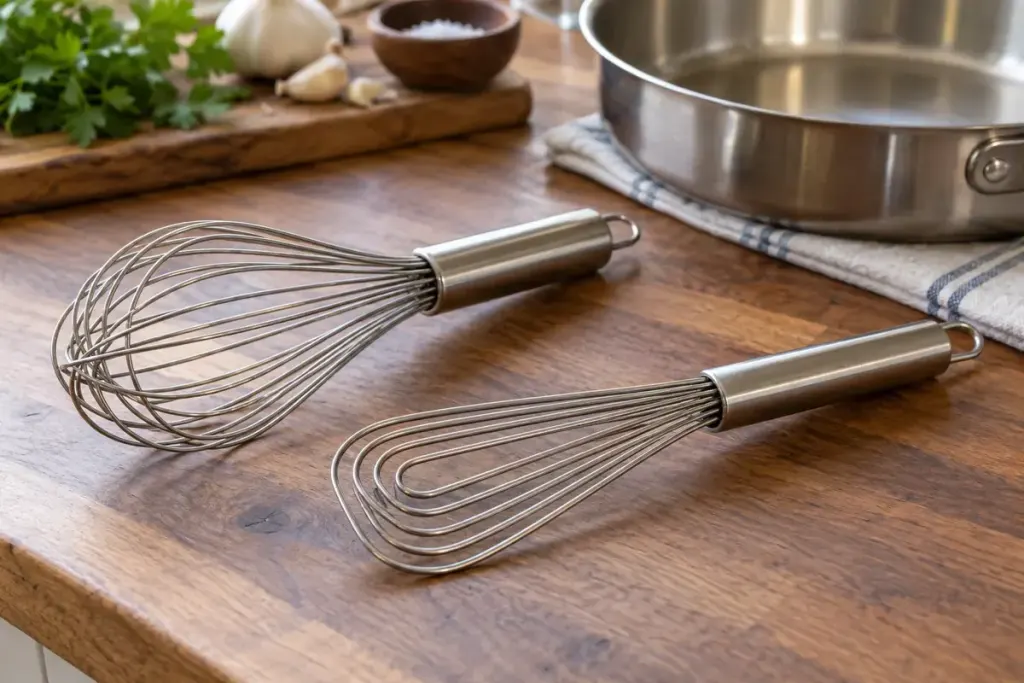
A balloon whisk moves easily through a deep bowl, then feels awkward in the shallow corners of a saucepan. The problem may be the tool’s shape rather than the recipe.
A balloon whisk has a rounded cage of loops. A flat whisk arranges its wires in a much flatter profile. That changes where the wires can reach and how the tool moves against the base of a vessel.
Match the reach to the container
Try the clean tools in an empty, cool bowl and pan. Notice which parts of the base each whisk can contact comfortably without forcing the handle into an awkward angle. A flat whisk can be useful for working across a shallow pan, while a balloon shape offers room for movement through a deeper mixture.
The label is not the whole choice. Handle length, wire stiffness, tool size and the vessel’s shape all affect control. A large whisk in a small bowl can splash even when it is the right general type.
Check the surface compatibility
Follow the cookware maker’s guidance on utensils. Metal wires may be unsuitable for some coated surfaces. A coated whisk also needs inspection for damage and a suitable heat rating; do not assume every soft-looking covering tolerates every cooking task.
For an original comparison, use a small amount of cool water in two suitable vessels and observe the tool’s reach. This low-stakes test reveals geometry without risking a hot sauce or scratching an expensive pan.
Choose for the movement you repeat
If you mostly whisk eggs in a mixing bowl, a comfortable balloon whisk may earn its space. If you frequently stir a shallow pan sauce, a suitable flat whisk may be helpful. You do not need both simply because a catalogue presents them as a set.
Wash and dry according to the tool’s instructions, paying attention to where wires join the handle. Replace a damaged tool that sheds coating or has a loose wire.
The useful distinction is visible in the path of the wires. Choose the whisk that reaches the mixture comfortably in the vessel you actually use, rather than trying to make one shape perform every movement.