
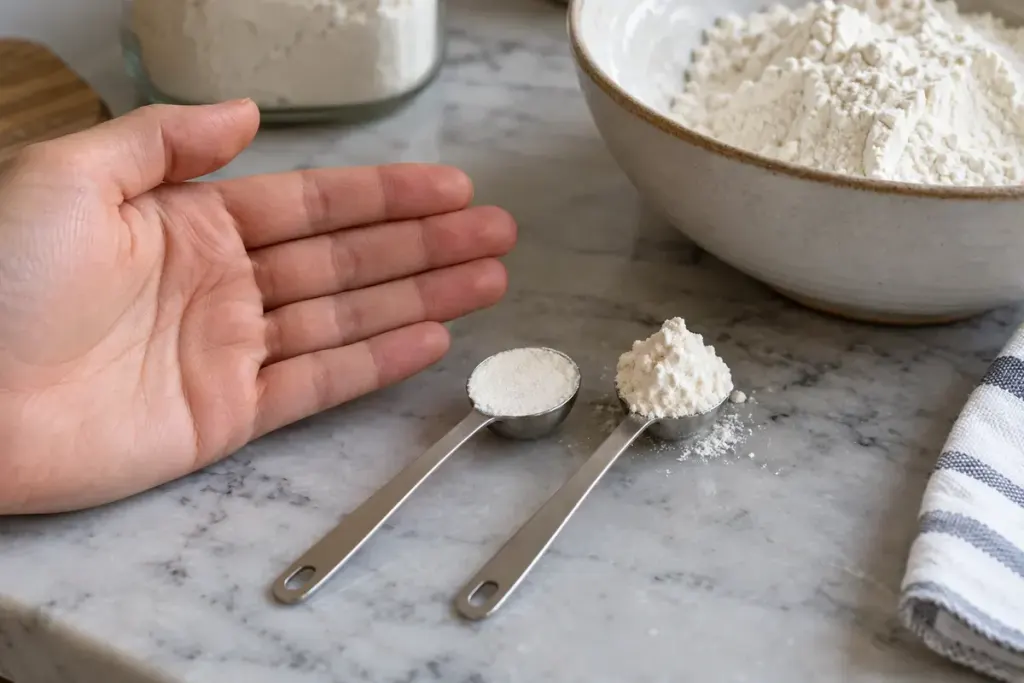
Two people use the same measuring spoon and add different amounts of flour. One levels it across the rim; the other leaves a mound. The tool is identical, but the measurement is not.
Read the fill instruction
A level measure ends at the spoon’s rim. A rounded or heaped measure extends above it and is less precisely defined unless the recipe explains its method. Do not silently substitute one for another, especially when a small ingredient amount strongly affects the result.
Check the capacity printed on the measuring set and the measurement system used by the recipe. An ordinary eating spoon is not a reliable substitute for a specified measuring spoon. Different countries and recipes may also use different conventions for familiar unit names.
Keep the ingredient’s behaviour in mind
A powder that has compacted in its container may fill differently from one that has been loosened. A sticky paste may leave a substantial amount on the spoon. Follow the recipe’s method rather than repeatedly tapping, packing or scraping without noticing what changes.
For a repeatability exercise, measure the same dry ingredient three times with the stated method and weigh each portion on a suitable scale. You are not establishing a universal conversion; you are seeing how consistently you use that spoon with that ingredient.
If the recipe provides a mass in grams, that can avoid some ambiguity, provided the scale is appropriate for the amount. Very small quantities may be below the useful resolution of a general kitchen scale, so do not assume every displayed zero is meaningful.
Keep the spoons dry for dry ingredients and clean them between incompatible ingredients. Read the care instructions before putting a set in the dishwasher, particularly if printed markings are already fading.
When a recipe works, note the actual measure and filling method. “One level 5 mL spoon” is much easier to repeat than “a small spoonful.” A modest tool becomes more useful when the action used to fill it is just as clear.